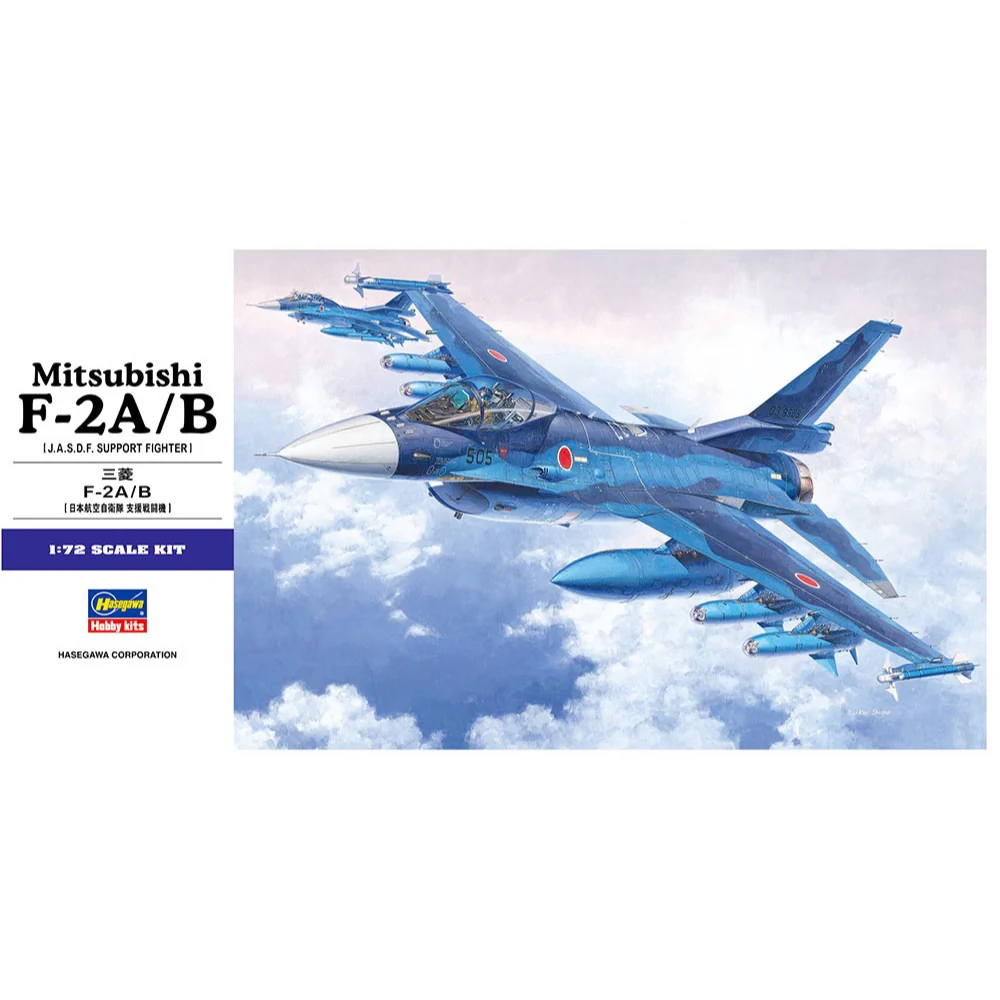

Hasegawa 01545 1/72 Mitsubishi F-2A/B
The Mitsubishi F-2 is a support jet fighter of the Japan Air Self-Defense Force. There are two types of this aircraft: the single-seat A model and the two-seat B model, with the two-seat model being mainly used for educational and training purposes.
The Japan Air Self-Defense Force ( JASDF) has deployed the F-15J interceptor fighter to defend against threats from fighter jets and bombers , and the F-1 support fighter to defend against threats from ships and tanks, but the F-1s are beginning to be retired due to their aging. The F-2, jointly developed by Japan and the United States, is the successor to the F-1.
Initially called the FS-X, this aircraft is based on the F-16 and is designed using the latest technology. Its distinctive exterior design includes a fuselage and wings that are slightly larger than those of the F-16, a larger radome to accommodate a new radar, and a three-section canopy to protect against bird strikes during low-altitude flight. Japan's world-renowned carbon-based composite materials are used in various parts of the aircraft, including the wings, reducing the aircraft's weight.
Original: $21.46
-65%$21.46
$7.51Product Information
Product Information
Shipping & Returns
Shipping & Returns
Description
The Mitsubishi F-2 is a support jet fighter of the Japan Air Self-Defense Force. There are two types of this aircraft: the single-seat A model and the two-seat B model, with the two-seat model being mainly used for educational and training purposes.
The Japan Air Self-Defense Force ( JASDF) has deployed the F-15J interceptor fighter to defend against threats from fighter jets and bombers , and the F-1 support fighter to defend against threats from ships and tanks, but the F-1s are beginning to be retired due to their aging. The F-2, jointly developed by Japan and the United States, is the successor to the F-1.
Initially called the FS-X, this aircraft is based on the F-16 and is designed using the latest technology. Its distinctive exterior design includes a fuselage and wings that are slightly larger than those of the F-16, a larger radome to accommodate a new radar, and a three-section canopy to protect against bird strikes during low-altitude flight. Japan's world-renowned carbon-based composite materials are used in various parts of the aircraft, including the wings, reducing the aircraft's weight.